 PE
Team Memory
Relay
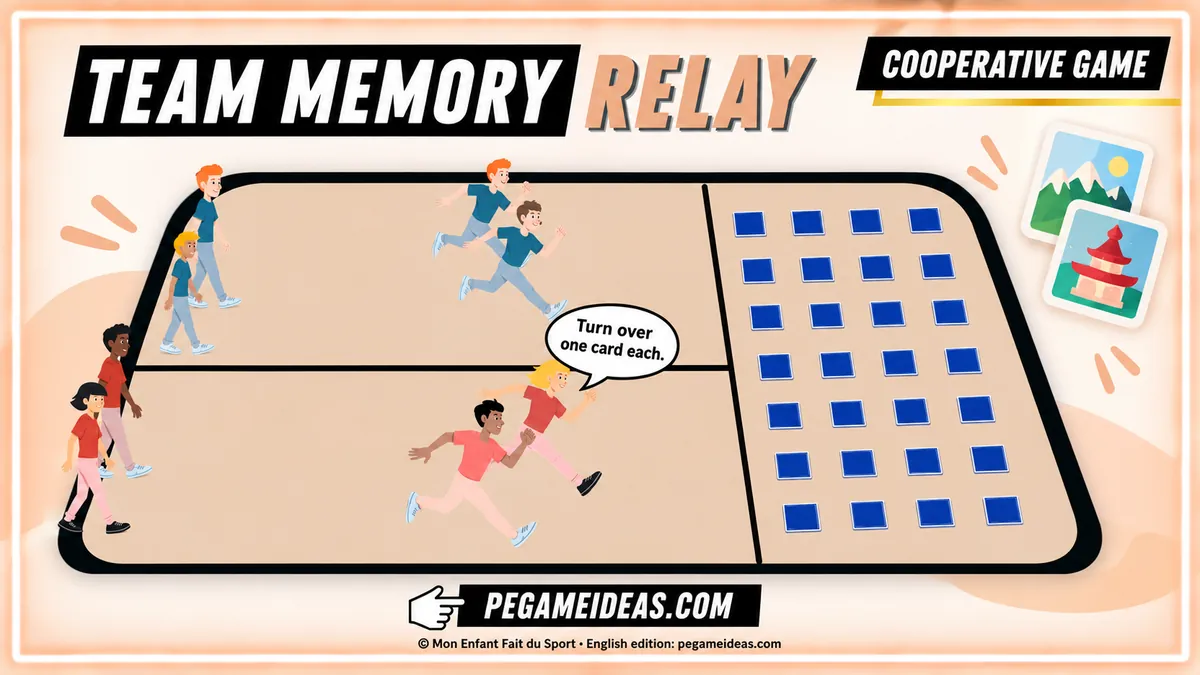
Team Memory Relay is the famous memory game turned into a relay race: in pairs, players run to turn over the cards and have to remember together where they are, to bring back as many pairs as possible to their side.
Click to watch the game in English, about two minutes.
Remember the cards and collect matching pairs together.
Setup & equipment
 The 35 Cooperative Games book, explained step by step and ready to print.Take a look
How to play, step by step
Lay out the cardsPut the cards face down in a grid at the far end of the area. Divide each team into pairs, waiting behind its start line.
Send the first pairsThe first pair from each team runs to the cards. Each player turns over one card, so the pair reveals two.
Match or rememberIf the two cards match, bring them back to your team. If not, turn both face down in the same places and come back empty-handed.
Share and relayTell your teammates what you saw and send the next pair. Keep going until all pairs are collected.
How to succeed
The team with the most matching pairs wins.
Play smart
- Keep the card area spacious, and no snatching.
- If two pairs reach the same card, pause and give each a clear turn.
Skills kids work on
Each player
- Visual memory
- Relay running
- Finding your way in space
- Putting things into words
The group
- Passing on information
- Working in pairs
- Listening to teammates
- Playing honestly
Go further
Want every one of these cooperative games in one place?
Team Memory Relay is in it, with the whole collection: 35 cooperative games, each on two pages, explained step by step and ready to print. Never short of an idea again.
Coach’s tip
The trap is putting the cards back. A pair in a hurry drops the cards anywhere, and two turns later the whole team's memory is wrong: nobody finds anything and the game turns into pure luck. I insist on it during setup, and I play a demo round myself, putting the cards back exaggeratedly slowly. They understand right away why it matters.
The second habit is getting returning pairs to talk. I simply ask when they come back: what did you see? Without that, everyone keeps their information to themselves and the game loses its whole team side. With it, kids invent their own landmarks within two rounds: the corner card, the one next to the red cone.
Xavier, state-certified youth sports instructor (BPJEPS, France)
You might also like
Frequently asked questions
What age is Team Memory Relay for?
From 5 with six to eight pairs. Visual memory is already there in kindergarten; it's the number of cards that sets the difficulty. From third grade, go up to fifteen pairs and move the cards farther away, so tiredness adds to the memory challenge.
Does it work with preschoolers?
Yes, with six pairs and very contrasting pictures, animals or colored shapes, never similar patterns. With the youngest, skip putting cards back face down: unmatched cards stay face up, which turns it into an observation race, plenty at that age.
How many cards do I need?
About one pair per player, with a minimum of six. Too few pairs and the game ends before memory matters; too many and pairs go back and forth without ever matching anything. Printed, laminated pictures work fine: no need to buy a memory game.
Can you play it indoors?
It's even easier indoors: the cards don't blow away. Lay the cards out in a clearly marked, not too big area, or pairs spend their time searching instead of remembering. A mat on the floor marks the area very well.
Official English edition of a game sheet by Xavier Baugé, the author of this game, first published in French on Mon Enfant Fait du Sport. Also available in Spanish.