 PE
Sound
Partners
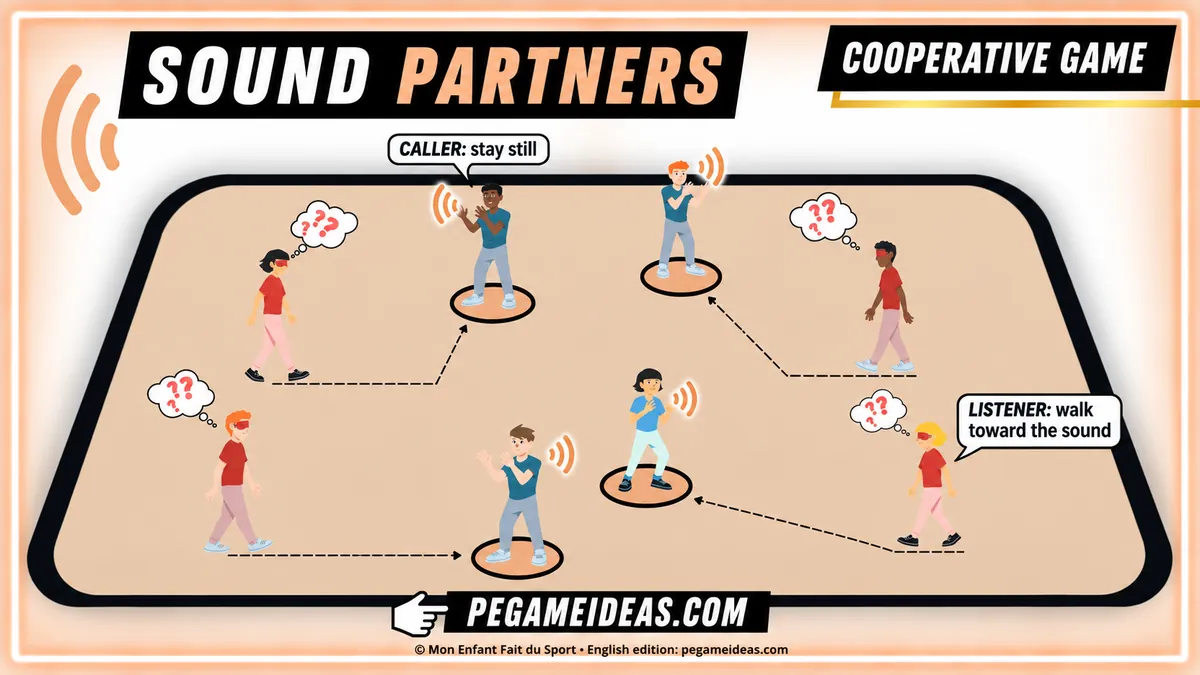
One child is blindfolded, their partner stands still somewhere in the area, and the only link between them is a sound they invented together. No sentences allowed.
Find your partner by following a sound you share.
The goal of the game
Find your guide in an area where everyone is calling at once, using only the pair's invented sound. Nobody is out: every pair ends up finding each other.
Setup & equipment
 The 35 Cooperative Games book, explained step by step and ready to print.Take a look
How to play, step by step
Choose a soundMake pairs. Each pair invents its own sound, like a clap pattern or an animal call. Use sounds, not words.
Place the callersCallers spread out and stay still. Listeners start a short distance away, with an optional blindfold.
Call and answerThe listener makes the agreed sound, the caller answers with the same sound, and the listener walks slowly toward it.
Switch rolesWhen partners meet, reset their positions and swap roles, so both players listen and call.
How to succeed
Each pair succeeds when both partners have found each other by sound.
Key rules to remind the group
- No words, ever. One word spoken and the pair starts again from the edge.
- The guide doesn't move their feet: they can only answer.
- The guide only answers when they hear their own sound, not nonstop.
More ways to play
- Groups of three: one blindfolded child, two guides who have to make the sound together, at exactly the same time.
Make it easier or harder
Easier
- With 5-year-olds, cut the area in half and send only three pairs at a time.
Harder
- Draw sounds out of a hat instead of choosing them: pairs can't cheat with an obvious code.
- Cluttered version: place a few cones on the floor that the blindfolded player must go around without touching.
Play smart
- Keep the route clear and supervise closely.
- No racing. Offer eyes-open play: this is a listening game.
Skills kids work on
Each player
- Picking out a sound in noise
- Moving without sight
- Inventing a code
- Slowing your steps
The group
- Trusting a partner
- Holding your spot
- Respecting the no-words rule
- Swapping roles
Go further
Want every one of these cooperative games in one place?
Sound Partners is in it, with the whole collection: 35 cooperative games, each on two pages, explained step by step and ready to print. Never short of an idea again.
Coach’s tip
This is the game I pull out when a group has stopped listening to each other. In thirty seconds the area turns into a racket of sounds, and then the pairs start finding their sound in the middle of it all. It's amazing to watch: kids lower the volume on their own because they realize that if everyone shouts, nobody hears anything.
The one setting that matters: no names, from the very start. Without that rule, half the pairs are calling each other's names after ten seconds and the game is gone. I say it, repeat it, and the first one who uses a name sits out one turn. Once is enough for the whole activity.
Xavier, state-certified youth sports instructor (BPJEPS, France)
You might also like
Frequently asked questions
What age is Sound Partners for?
From 6. Before that, most kids lift the blindfold after ten seconds, not to cheat but because moving without seeing really worries them. With 4 and 5-year-olds, use hands over the eyes instead: they stay in control and the game still works.
A child refuses the blindfold. What do I do?
Never force it. Offer them the caller role, which is just as interesting and often harder to hold. Many accept the blindfold on the second turn, once they've seen that nobody bumps into anything. And always allow simply closing your eyes.
How many pairs can play at once?
Up to fifteen pairs on a big area. Past that, the noise gets so loud that even a good sound can't be heard. Then let half the group play while the other half watches, and switch: watchers learn a lot from seeing other pairs' strategies.
How do I keep it safe?
An area with no obstacles, no nearby walls and no slopes is the minimum. Add two players without blindfolds who walk around as lookouts and gently stop anyone about to leave the area. And ask everyone who moves without seeing to keep their hands out in front of them.
Can you play it indoors?
Very well, and it's easier to manage: the walls mark the area without drawing anything. But sound bounces and blurs the cues, so have fewer pairs play at once. Outside it's the opposite: more room, but sound fades, so bring the area in.
Official English edition of a game sheet by Xavier Baugé, the author of this game, first published in French on Mon Enfant Fait du Sport. Also available in Spanish.