 PE
Hoop Handoff
Relay
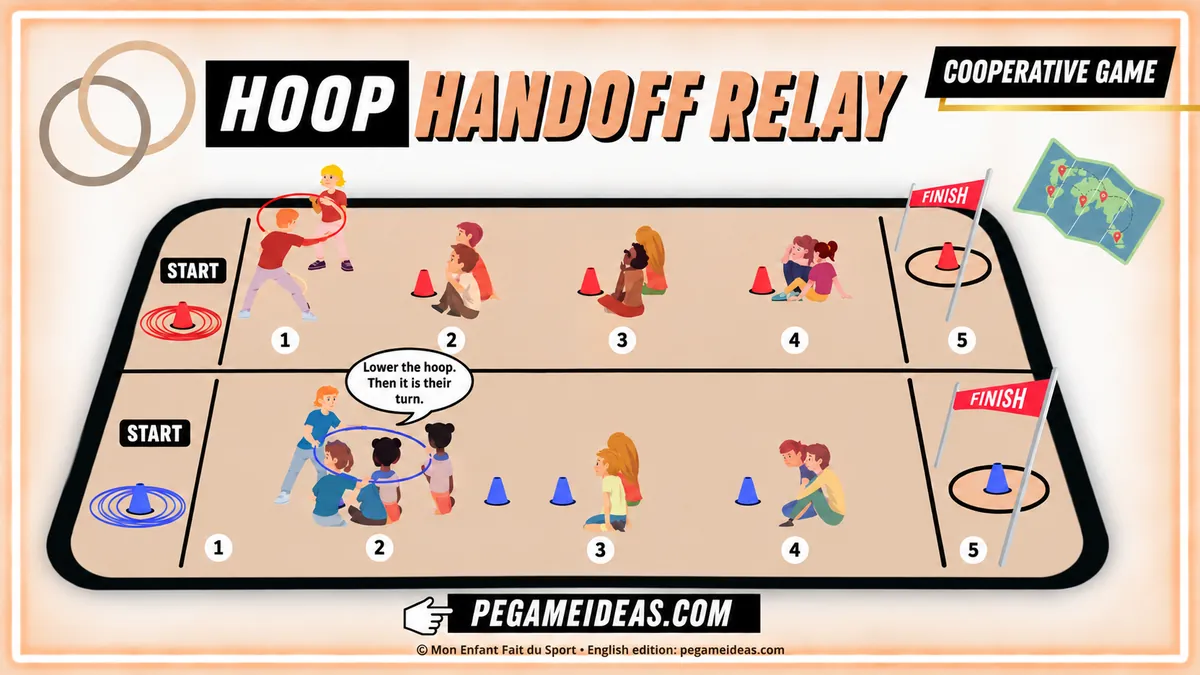
Pairs sitting along a line, a hoop that travels from pair to pair, and one simple rule: you only stand up when the hoop is around you. Sounds easy.
Move all the hoops from station to station with synchronized partner handoffs.
The goal of the game
Move every hoop to the finish, carried from pair to pair, with each pair allowed to move only once the hoop is around them.
Setup & equipment
 The 35 Cooperative Games book, explained step by step and ready to print.Take a look
How to play, step by step
Build the stationsMake two teams of eight: four pairs per team. Set out 5 cone stations and put 5 hoops at station 1. One pair sits beside each of stations 1 to 4. Station 5 is the finish.
Lift togetherThe first pair takes a hoop, carries it together to the next pair, and gently lowers it around them with their agreement.
Pass the turnThe receiving pair stands up, lifts the hoop and carries it on. The delivering pair goes back to its station. Wait until the next pair is back, seated and ready before bringing another hoop.
Finish the chainThe last pair lowers each hoop around the finish cone, then returns to station 4. Repeat until all 5 hoops reach the finish.
How to succeed
The first team to deliver all its hoops to the finish cone wins.
Key rules to remind the group
- A pair only stands up when the hoop is really around them.
- The hoop is carried by two, never by one child.
- Once the hoop is delivered, the pair goes back to sit at its station.
More ways to play
- Beat your own time: the group moves all five hoops, notes its time, then tries again to beat it.
Make it easier or harder
Harder
- Two hoops moving at the same time: the chain has to manage a flow, and the middle pairs hardly stop.
- Add a weave between two cones: carrying a hoop in pairs while weaving suddenly takes much more coordination.
- With 9- to 12-year-olds, ban talking. Pairs have to sync by eye, and the rhythm becomes surprisingly steady.
Play smart
- Don't drop hoops over heads or trap arms.
- Wait until partners are ready before lowering or lifting a hoop.
Skills kids work on
Each player
- Walking in step with someone
- Carrying in pairs
- Waiting your turn seated
- Standing up quickly
The group
- Syncing with the pair before
- Handing over cleanly
- Keeping a steady rhythm
- Cheering without standing up
Go further
Want every one of these cooperative games in one place?
Hoop Handoff Relay is in it, with the whole collection: 35 cooperative games, each on two pages, explained step by step and ready to print. Never short of an idea again.
Coach’s tip
It's the calmest game on this list, and that's exactly why I use it. After a big game that got everyone fired up, this one brings the group back to a steady pace without anyone feeling that we stopped. Seated pairs wait, stand up, walk, sit back down.
The rule that makes the game interesting is waiting until the hoop is really around you. Without it, everybody stands up at once and it turns into a crowd. With it, the chain takes shape and you can clearly see the relay move down the line. It's the kind of detail that makes all the difference.
Xavier, state-certified youth sports instructor (BPJEPS, France)
You might also like
Frequently asked questions
What age is Hoop Handoff Relay for?
From 6; it's one of the easiest: walking in pairs with a hoop around you isn't complicated. With 4 and 5-year-olds, use three stations and let them carry the hoop in their hands instead of around their bodies.
How many pairs per team?
Four to five pairs, one per station. With more, the space between stations gets too short to matter, or the line stretches so far that the last pair waits two minutes doing nothing. Set up a second team side by side instead.
What if I don't have hoops?
A rope tied in a loop is even handier: it slips easily around two children and never gets stuck. An inner tube, a big scarf tied in a loop or a gym elastic band also work. The loop just needs to be big enough for two.
The game is too easy. What do I do?
Add a second hoop in play: it's the most effective setting. Pairs in the middle then have to deal with a hoop arriving while they're coming back from the last one. A slalom between the stations works well too, especially with older kids.
Can you play it indoors?
Very well; it just needs length: about 50 feet (15 meters) to line up five stations with space between them. It's also one of the few games where a hard floor is no problem, since everyone walks. Outside, grass is perfect.
Official English edition of a game sheet by Xavier Baugé, the author of this game, first published in French on Mon Enfant Fait du Sport. Also available in Spanish.