 PE
Co-Pilot
Course
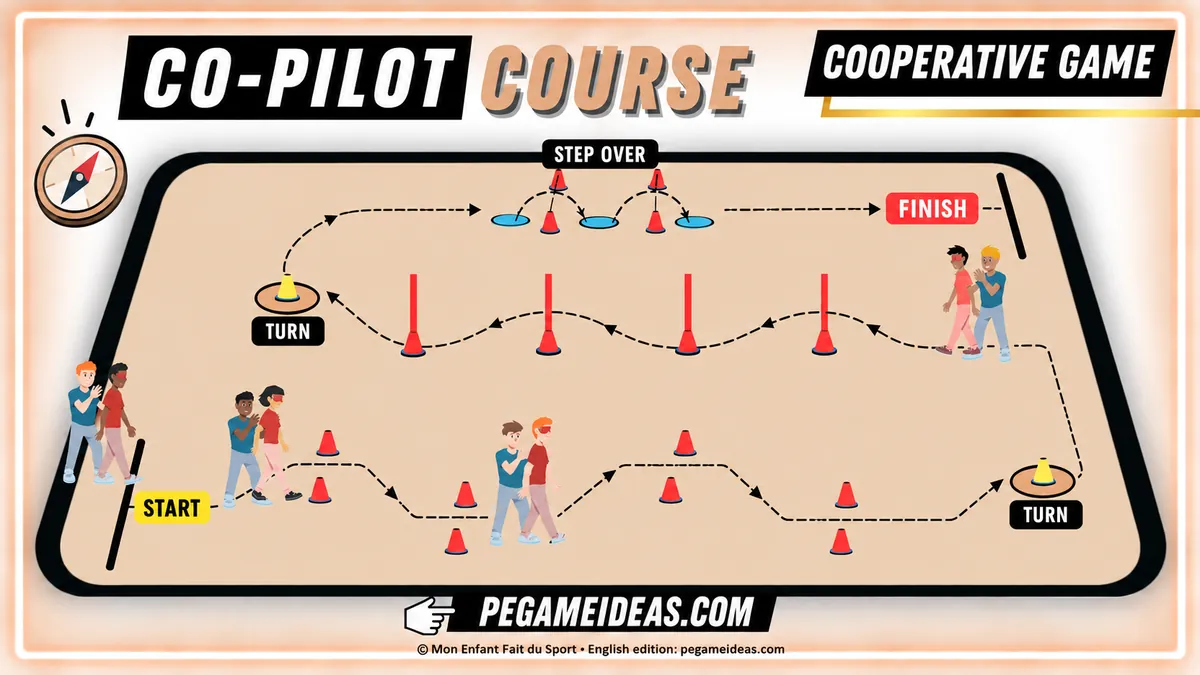
An obstacle course, a pilot who can't see, and a co-pilot who has the voice and the hand. Then you swap, and the co-pilot finds out what they just put their partner through.
Click to watch the game in English, about two minutes.
Guide a partner through the course with clear directions and a shared pace.
The goal of the game
Get through an obstacle course in pairs, one blindfolded and the other guiding, then do the route the other way with roles swapped.
Setup & equipment
 The 35 Cooperative Games book, explained step by step and ready to print.Take a look
How to play, step by step
Set the courseUse cones to make wide gates, a slalom and turning points. Keep step-over obstacles very low and stable. Walk the course with eyes open before playing.
Agree how to guidePartners choose voice guidance and, with permission, a light touch on the arm or shoulder. The blindfold is optional; agree on a clear stop word.
Move slowlyThe guide walks beside their partner, describes what comes next and matches their pace through gates, around cones and over the low obstacles.
Swap rolesAt the finish, remove any blindfold, talk about what helped, and swap roles.
How to succeed
The pair succeeds when both players have completed the course in both roles.
Key rules to remind the group
- The co-pilot never lets go of the pilot, from start to finish.
- Always announce an obstacle before reaching it, never during.
- The pilot may stop whenever they want, without having to explain.
More ways to play
- Silent version: the co-pilot can't talk, only guide by the hand. Pairs invent their own signals.
Make it easier or harder
Easier
- With 5-year-olds, use low hurdles: 6 to 8 inches is enough. At that height they step over without seeing, as long as the pilot is warned one step ahead.
Harder
- Voice only: the co-pilot can't touch, only talk. Much harder, best for kids 8 and up.
- Busy traffic: two pairs start at the same time in opposite directions on the same course, and must pass each other without touching.
Play smart
- An adult watches the course.
- Never pull a partner or ask a blindfolded player to jump. Stop if anyone is uncomfortable.
Skills kids work on
Each player
- Moving without sight
- Stepping over with confidence
- Describing what you see
- Adjusting your stride
The group
- Trusting a partner
- Announcing before acting
- Understanding the other role
- Taking care of a partner
Go further
Want every one of these cooperative games in one place?
Co-Pilot Course is in it, with the whole collection: 35 cooperative games, each on two pages, explained step by step and ready to print. Never short of an idea again.
Coach’s tip
Swapping roles isn't a detail, it's the whole game. A child who rushed their partner a bit understands it in three seconds when it's their turn to wear the blindfold. I've never seen a second trip as fast as the first, and it sorts itself out without me saying a word.
I always keep the step-over obstacles very low: about four inches (10 cm) is enough. Height isn't what makes the game, stepping over without seeing is. An obstacle that's too high and the follower refuses or bumps into it, and the pair loses the trust it took ten minutes to build.
Xavier, state-certified youth sports instructor (BPJEPS, France)
You might also like
Frequently asked questions
What age is Co-Pilot Course for?
From 6, with a simple course and guiding by the arm. Voice-only guiding means describing a space precisely, which really comes around 8 or 9. With 5-year-olds, keep the obstacles very low; it works fine if the guide announces each one a step before.
What if I don't have low obstacles?
A rope on the ground, a low bench, a row of cones lying down, or a broom handle resting on two cones all work. The obstacle must be easy to step over and not hurt if a foot catches it. Avoid anything rigid at shin height.
How many pairs at once?
One pair per course, or collisions are guaranteed. With a big group, set up three parallel courses with the equipment shared out, or let half the group play while the other half watches. Watchers spot guiding mistakes very well.
How do I keep it safe?
No rigid obstacles, no wall corners within about six feet (2 meters) of the course, and the guide always stays beside their partner. No running, even on the way back. And remind everyone before starting that the follower can say stop at any moment: that one sentence settles almost every worry.
Can you play it indoors?
Yes, it's even easier: the floor is even and you can see the walls right away. You need a room at least 25 feet (8 meters) long for the course to make sense. Outside, pick flat ground and clear away stones.
Official English edition of a game sheet by Xavier Baugé, the author of this game, first published in French on Mon Enfant Fait du Sport. Also available in Spanish.